
catch weld defects at the source — before they become failures.
solutions - weld defect detection
Incomplete welds, porosity, spatter, and burn-through compromise structural integrity in ways that aren't always visible to the naked eye at line speed. By the time a weld defect is found in the field, the cost is no longer a rework call — it's a warranty claim, a recall, or a liability. Detect-It inspects every weld in real time, at the station, the moment it's made.
the numbers
73%
OF WELD DEFETS ARE NOT DETECTED BY VISUAL INSPECTION ALONE
24hr
FASTEST DETECT-IT DEPLOYMENT FOR AEROSPACE & DEFENSE CUSTOMERS
0
LINES OF CODE REQUIRED TO BULD. AND DEPLOY A WELD DETECTION NET
Weld defects are among the most dangerous quality escapes in manufacturing — and among the most difficult to catch consistently at line speed. AI vision trained on your actual welds, running live on your production line, is the only scalable solution that catches defects at the moment they occur rather than after the part has moved downstream.
THE PROBLEM
WHY WELD DEFECTS ESCAPE INSPECTION
Weld quality inspection is one of the most challenging problems in manufacturing. Many defects — porosity, subsurface cracking, incomplete fusion — aren't visible on the surface at all. Those that are visible may only be detectable under specific lighting conditions or at close range, neither of which is practical at production line speed.
Human inspectors can't reliably identify subtle weld defects on every part at production speed over an entire shift. Traditional machine vision systems struggle with the variable appearance of welds — the same defect can look dramatically different across different base materials, weld processes, wire types, and lighting conditions.
Detect-It's AI vision learns from your actual welds — the specific defects that appear on your specific parts, in your specific process environment — making it dramatically more accurate than rule-based vision systems on real production weld inspection.
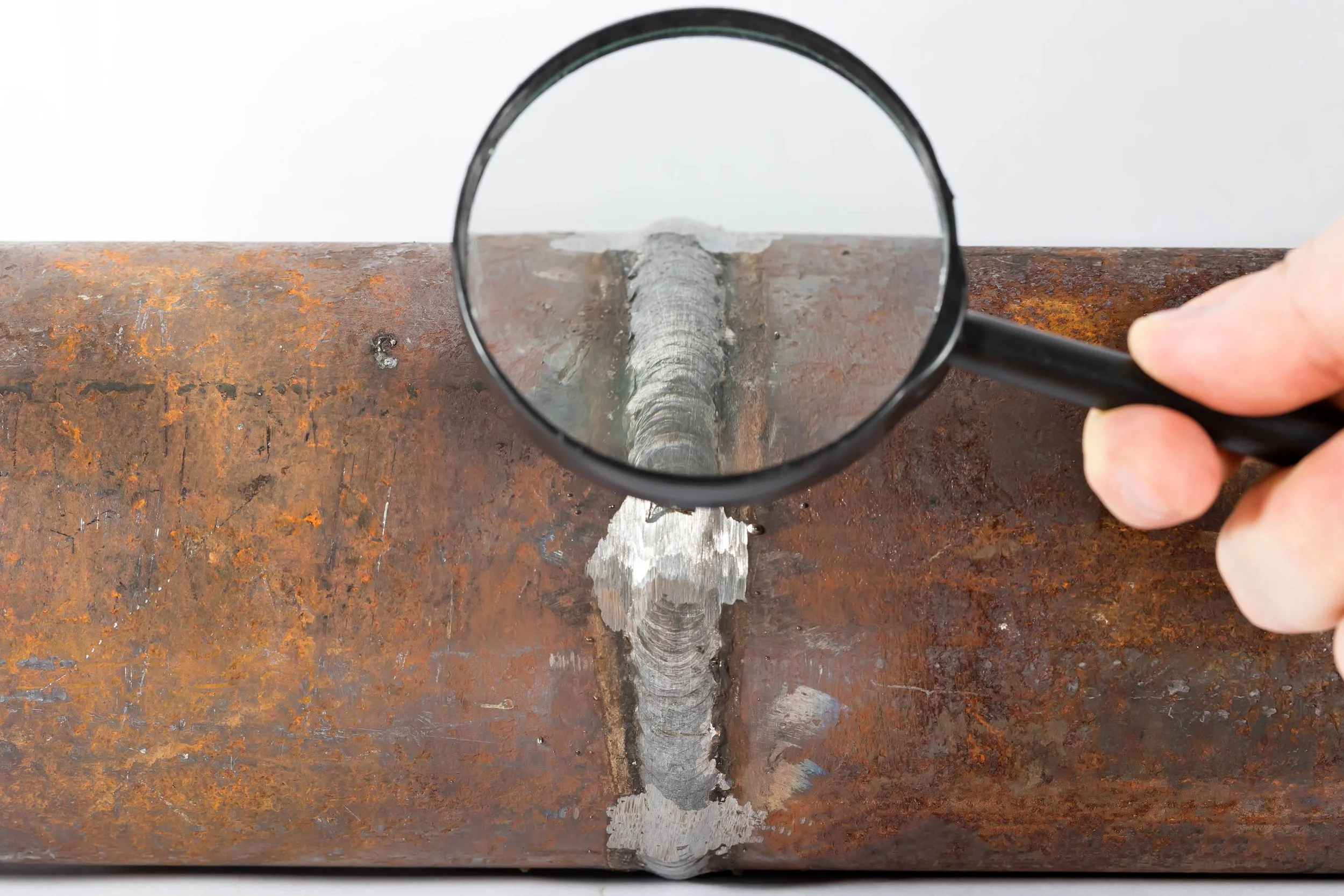
porosity
Gas pockets trapped in the weld that weaken the joint. Often appear as small round voids on or near the weld surface. Common in MIG and TIG processes when shielding gas coverage is inadequate.
incomplete fusion
The weld metal fails to fuse completely with the base metal or previous weld pass. One of the most structurally dangerous defect types — difficult to detect visually but identifiable in the weld bead profile.
spatter
Molten metal droplets expelled during welding that land on the base material. Indicates process instability and can mask other defects. Detect-It identifies abnormal spatter patterns in real time.
burn-through
Excessive heat causes the base metal to melt through, creating a hole in the weld. Easily detected visually but often missed at line speed by human inspectors fatigued at end of shift.
undercut
A groove melted into the base metal adjacent to the weld that is not filled by weld metal. Reduces the effective cross-section of the base metal and creates a stress concentration point.
weld position error
The weld bead is placed in the wrong location on the joint. Detect-It can verify that each weld is positioned correctly relative to fixed reference points on the part.
the detect-it solution
AI trained on your welds — running live at your station
Detect-It trains a weld inspection net from video of your actual welding process — capturing the specific defect types, lighting conditions, base materials, and weld profiles that appear in your environment. The resulting net is tuned to your process, not a generic weld inspection model.
Once deployed via Net Runner, the system watches every weld as it's made — generating a pass/fail result in real time, logging each inspection with a timestamped image, and triggering a reject signal or alert to your PLC or MES when a defect is detected. Rework happens at the station, not downstream.
trained on your process
Not a generic weld model — trained on your specific welds, your materials, your lighting, and your defect types. Significantly more accurate than rule-based systems on real production welds.
real-time at-station detection
Flags defects the moment they occur — before the part moves to the next station, not at end-of-line or at the customer.
any camera, on premise
Runs on any off-the-shelf camera and NVIDIA GPU PC behind your firewall. No proprietary hardware, no cloud connection required.
complete weld traceability
Net Evidence stores visual inspection data for every weld by serial number — a complete quality record from weld to shipment.
what detect-it can detect
Don't see your specific weld defect type listed? Send us a video of your welding process and we'll show you what Detect-It finds.
see it in action
see it on your welds before you decide
Send us a video of your welding process and we'll build a real Detect-It net and show you exactly what it detects — at no cost, no obligation, results in 1–3 business days.